
When you are planning a new construction project, whether it is a small home extension or a large-scale housing development, one of the first hurdles you will encounter is how to deal with surface water. In the past, many developers simply connected rainwater pipes to the local sewer system, but those days are largely over. Local authorities and water companies in the UK now have strict requirements to ensure that new developments do not overwhelm existing infrastructure or increase the risk of flooding elsewhere. This is where the concept of Sustainable Drainage Systems (SuDS) comes into play, and at the heart of many SuDS designs is the soakaway.
To design an effective soakaway, you cannot just guess how quickly water will soak into the ground. You need hard data, and that is precisely what a BRE365 Infiltration Test provides. This specific test is named after the Building Research Establishment (BRE) Digest 365, which sets out the industry-standard methodology for determining the infiltration rate of soil. It is a rigorous process that ensures any drainage system installed is fit for purpose and capable of handling intense rainfall events over many decades.
What Exactly Is the BRE365 Infiltration Test?
The BRE365 Infiltration Test is a field-based assessment used to calculate how quickly water can permeate through the soil at a specific location. Unlike simpler percolation tests used for septic tank drainage fields, the BRE365 method is designed specifically for surface water soakaways. It is a much more robust test because it accounts for the fact that soil behaves differently when it becomes saturated during prolonged periods of heavy rain.
The primary goal of the test is to find the ‘soil infiltration rate,’ which is then used by drainage engineers to size the soakaway correctly. If the soil absorbs water slowly, you will need a larger soakaway with more storage volume. If the soil is highly permeable, like sand or gravel, the soakaway can be smaller. Without this data, you risk either over-engineering the system—which wastes money—or under-engineering it, which could lead to garden flooding or even structural damage to your property.
Why Planning Departments Insist on BRE365
If you are applying for planning permission, your local council will likely ask for a drainage strategy. In almost all cases, the ‘hierarchy of drainage’ must be followed. This hierarchy dictates that you must first try to discharge water into the ground via infiltration before considering a watercourse or, as a last resort, a public sewer. To prove that infiltration is or isn’t viable, you must provide the results of a BRE365 Infiltration Test.
- It provides a standardised methodology that councils trust.
- It ensures the drainage system can cope with a 1-in-100-year storm event plus an allowance for climate change.
- It prevents the long-term failure of soakaways caused by siltation or soil saturation.
- It helps in identifying the local water table level, which is crucial for design.
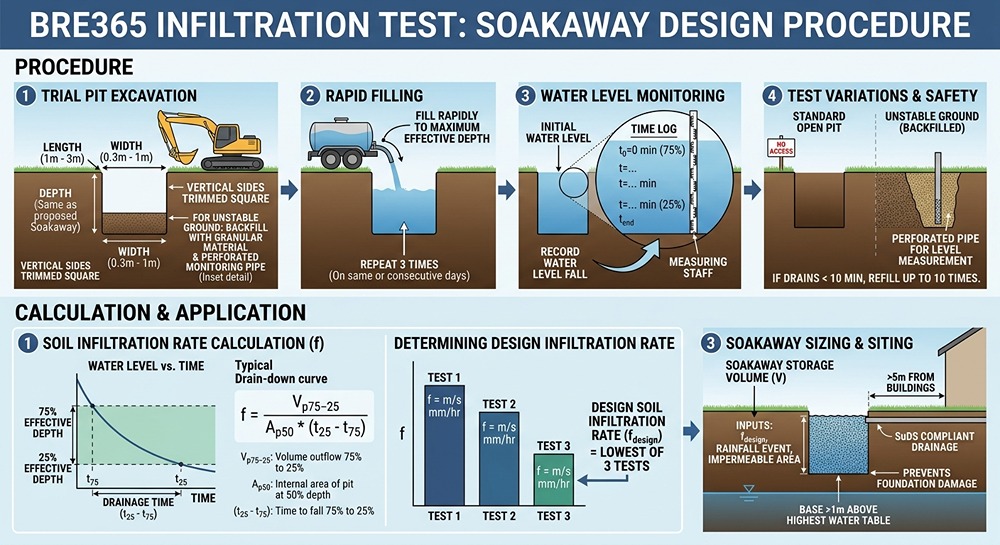
The Step-by-Step Process on Site
Conducting a BRE365 Infiltration Test is a labour-intensive process that usually requires heavy machinery. It is not something that can be done with a hand shovel in twenty minutes. Here is how a typical test day unfolds:
Excavating the Trial Pit
First, a trial pit is excavated using a digger. The dimensions of this pit are critical; it is usually between 1 and 3 metres deep, depending on the proposed depth of the final soakaway. The width and length are also carefully measured. The sides of the pit must be vertical and trimmed clean to ensure that the water can soak into the soil faces without being blocked by loose debris.
The Three-Fill Requirement
One of the most important aspects of the BRE365 methodology is that the test must be repeated three times. This is where many DIY attempts fail to meet the standard. You fill the pit with water (often using a large water tanker or a high-flow hydrant) and time how long it takes for the water to drop from 75% full to 25% full. Once it has drained, you fill it again, and then a third time.
The reason for this repetition is to simulate the conditions of a real-world storm. During a long period of rain, the soil becomes increasingly saturated. The first fill often drains quickly because the soil is dry, but by the third fill, the infiltration rate usually slows down. The slowest of the three rates is typically used for the final design calculations to ensure maximum safety.
Monitoring and Data Collection
During the test, an engineer will use a dip tape or an electronic sensor to record the water level at regular intervals. This data is then plotted on a graph to determine the precise infiltration rate. If the soil is particularly heavy clay, this process can take a long time—sometimes several days—which is why it is essential to plan the site works carefully.
What Happens After the Test?
Once the field work is complete, the data is taken back to the office for analysis. The engineer will calculate the infiltration rate (expressed in metres per second) and produce a formal report. This report will include:
- The location and dimensions of the trial pits.
- Logs describing the different soil layers encountered (e.g., topsoil, sandy clay, weathered chalk).
- The raw data from the three water fills.
- The final calculated infiltration rate.
- Observations regarding the presence of groundwater.
If the test results show a high infiltration rate, you are in luck. You can proceed with a standard soakaway design, which is usually the most cost-effective way to manage surface water. However, if the test fails—meaning the water doesn’t drop fast enough or at all—you will need to look at alternative solutions.
Dealing with Poor Infiltration Results
In areas with heavy clay soil, it is quite common for a BRE365 Infiltration Test to return poor results. While this can be frustrating, it is better to know this during the design phase than after you have built the house. If infiltration is not possible, your engineer might suggest:
- Attenuation Tanks: These hold the water during a storm and release it slowly into a watercourse or sewer at a controlled rate.
- Permeable Paving: This allows water to be stored in the sub-base of your driveway or patio.
- Rainwater Harvesting: Using the water for toilets or garden irrigation to reduce the total runoff.
- Crate Systems: Large plastic modular crates that provide a high void ratio for water storage.
Practical Considerations for Your Site
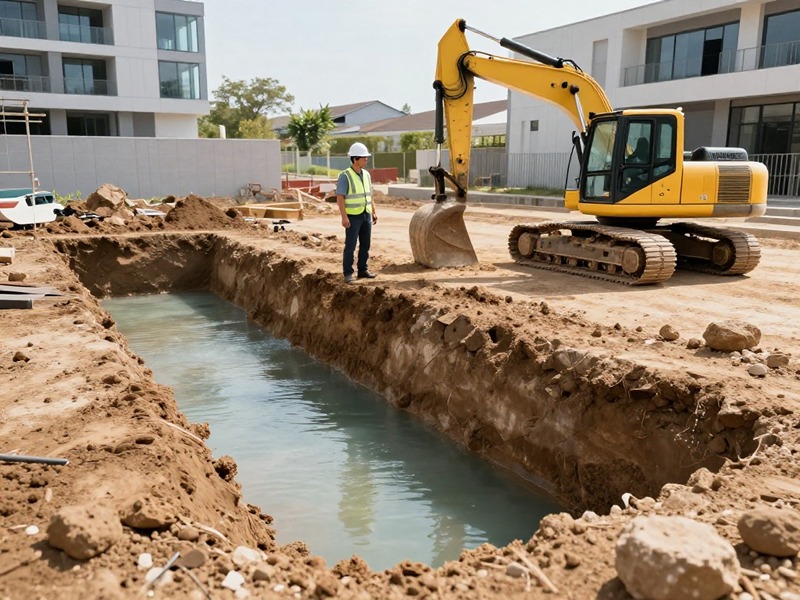
Organising a BRE365 Infiltration Test requires some logistical planning. You need to ensure there is clear access for a JCB or similar excavator to reach the test locations. You also need to consider the water supply. A standard garden hose is rarely sufficient to fill a large trial pit quickly enough to follow the BRE365 protocol; usually, a 2,000-gallon water bowser or a local hydrant permit is required to get the volume of water needed in a short space of time.
It is also worth noting that the timing of the test can be influenced by the weather. While the test is designed to simulate saturated conditions, conducting it during a period of extreme flooding might not give a representative view of the site’s average performance. Conversely, testing during a severe drought might require even more water to reach the necessary saturation levels for the second and third fills.
By investing in a professional test early in your project, you avoid the risk of your planning application being rejected or having to redesign your entire drainage system at the eleventh hour. It provides the certainty that your development will be resilient, compliant with UK building regulations, and environmentally responsible for years to come.

Janet Stacy specializes in creating relaxing home spa experiences with a focus on natural ingredients and mindful self-care rituals. She shares practical tips to transform everyday routines into soothing escapes.